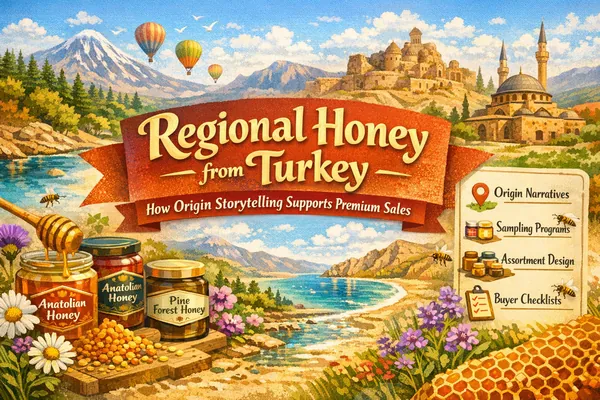
Premium honey is often sold on one of two concepts: botanical identity (monofloral) or place identity (regional). Regional honey belongs to the second category—its value comes from the story of where it comes from, how it fits in a curated assortment, and how confidently a buyer can reorder it without surprises.
Turkey is one of the world’s most recognized honey-producing geographies, and buyers often use Turkish regional lines to create a premium tier above “everyday blossom honey.” When executed well, a regional program can do three things at once: increase margin, improve differentiation, and grow basket size through bundles and gifting.
Move shoppers from core honey into premium jars.
Compete on identity and usage, not lowest price.
Documentation and batching reduce reorder friction.
Contents
1) Why regional lines matter in premium honey 2) Regional vs monofloral: a buyer-friendly distinction 3) The origin storytelling framework that sells (without overclaiming) 4) Sensory positioning: describe ranges, not absolutes 5) Sampling strategy: trial packs that convert premium buyers 6) Assortment design: the portfolio that performs 7) Packaging formats that reinforce premium value 8) Merchandising: shelf, display, and cross-category placement 9) E-commerce execution: bundles, subscriptions, and conversion assets 10) Buyer checklist for RFQ and launch 11) FAQ1) Why regional lines matter in premium honey
A regional line is a premium layer that is easier to explain than a technical honey classification. Customers understand place: a named region feels specific, curated, and giftable. That is why regional lines are common in specialty retail, gourmet grocery, and premium e-commerce.
Where regional lines typically win
- Gift and premium occasions: place names and story cards increase perceived value.
- Specialty assortment building: regional jars make the aisle look curated and “expert-led.”
- Sampling-to-trade-up: mini jars and tasting sets convert cautious shoppers.
- Portfolio pricing: a premium tier protects margins while the core SKU drives volume.
2) Regional vs monofloral: a buyer-friendly distinction
Buyers often confuse “regional” with “monofloral.” The distinction matters because it changes how you write labels, product pages, and sales scripts.
| Type | Primary identity | How it is usually marketed | Best use in a portfolio |
|---|---|---|---|
| Regional honey | Place (origin) | Origin story, harvest season, usage occasions | Premium tier + gifting + curated assortment |
| Monofloral honey | Plant (dominant floral source) | Flavor notes + botanical recognition | Differentiator line for enthusiasts and specialty buyers |
3) The origin storytelling framework that sells (without overclaiming)
The best origin stories are simple and repeatable. They work on a shelf tag, on a label, and in a buyer pitch. Avoid overloading customers with geography details they cannot remember. Instead, use a tight framework that answers: What is it? Why does it matter? How do I use it?
The 5-part origin story (buyer-safe and scalable)
- Place: Name the region clearly (one memorable phrase).
- Season: Mention harvest season timing as context, not a hard claim.
- Style: Blossom vs pine/honeydew (clarity reduces returns).
- Sensory direction: Describe range-based notes.
- Occasion: Give 3–5 usage ideas (breakfast, yogurt, tea, gifting).
4) Sensory positioning: describe ranges, not absolutes
Honey is naturally variable. Premium positioning is strengthened by honesty: give boundaries, not absolutes. This supports customer trust and reduces complaint risk.
A practical tasting-note template
- Sweetness: gentle / balanced / rich
- Aroma: floral-forward / herbal hints / mild spice notes
- Color: light-to-medium amber (range-based)
- Finish: clean / lingering / warm
- Texture: smooth; natural crystallization may occur
5) Sampling strategy: trial packs that convert premium buyers
Sampling is the fastest way to reduce “premium hesitation.” When a shopper is unsure, a trial pack converts better than a discount because it preserves premium value perception.
High-performing sampling options
- Mini jar trio: 3 origins or 2 origins + 1 pine for contrast.
- Discovery box: story card + tasting order + pairing suggestions.
- Bundle-with-core: add a mini regional jar to an everyday honey order.
- Corporate gifting sampler: premium minis with consistent branding.
6) Assortment design: the portfolio that performs
A premium program performs best as a portfolio. The most common mistake is trying to sell premium honey without a strong core SKU. Build your assortment like a ladder:
| Tier | Role | Typical format | Why it matters |
|---|---|---|---|
| Core | Volume + repeat purchase | Everyday blossom honey | Creates traffic and baseline trust |
| Differentiator | Contrast + education | Pine honey or monofloral | Expands the category in the customer’s mind |
| Premium origin | Margin + gifting | Regional jar + story card | Captures premium willingness-to-pay |
| Add-on | Basket expansion | Bee pollen / propolis blends / samplers | Improves AOV and strengthens brand ecosystem |
7) Packaging formats that reinforce premium value
Packaging is part of your story. Premium regional honey benefits from formats that look giftable, photograph well, and communicate quality through materials and finishing.
Formats that typically perform well
- Glass jars: premium shelf presence and gifting readiness.
- Boxed gift sets: seasonal peaks and corporate programs.
- Mini jars: trial conversion and bundling.
- Foodservice exposure: controlled formats (portion cups or curated table bottles) when aligned to channel.
Premium cues buyers notice
- Clean typography and consistent naming conventions across the regional series
- Batch/lot coding visible for QA and traceability confidence
- Short, readable story block (not a full paragraph) on pack or insert
- Usage icons or micro-suggestions (breakfast, yogurt, tea, cheese)
8) Merchandising: shelf, display, and cross-category placement
Most premium honey underperforms because it is merchandised like a commodity. Regional honey should be treated like a specialty product. Make sure the display answers: “Why is this different?” and “How will I use it?”
Simple retail tactics that work
- Tier placement: place regional jars above core honey to signal trade-up.
- Shelf talkers: one line origin + one line taste + one line best use.
- Cross-merchandising: tea, yogurt, cheese boards, gifting sections.
- Seasonal endcaps: holidays, Ramadan/Eid gifting windows, winter wellness season (avoid health claims).
9) E-commerce execution: bundles, subscriptions, and conversion assets
Online, the job is to remove uncertainty. Add conversion assets that explain the story quickly and give customers confidence.
Must-have conversion assets
- Hero image: clean pack shot + close-up texture photo.
- Short story: 3–5 lines maximum; keep it memorable.
- Tasting notes: range-based, not absolute.
- Usage section: 4–6 bullet ideas; add a “pairings” line.
- Storage guidance: short and practical; normalize crystallization.
Bundle ideas that increase AOV
- Regional trio: 2 regional blossoms + 1 pine honey
- Breakfast set: honey + tahini + tea (or aligned items)
- Gift set: premium jar + story card + optional accessory
10) Buyer checklist for RFQ and launch
RFQ inputs that reduce back-and-forth
- Destination country and target channel (specialty retail, mainstream retail, e-commerce, gifting)
- Preferred formats (glass jar / minis / gift boxes) and labeling language needs
- Target volumes (trial order + forecast for 2nd order)
- Any internal QA requirements (batch coding, spec sheet, compliance program needs)
Launch plan (simple, effective)
- Define 2–3 usage occasions you will market consistently
- Choose a sampling program (mini jars, trio packs, bundle add-ons)
- Build the ladder: core SKU + differentiator + premium origin
- Prepare shelf talkers / product page assets before inventory lands
11) FAQ
What is the difference between regional honey and monofloral honey?
Regional honey is typically positioned around geographic origin (place-based story) and can include multiple floral sources within a region. Monofloral honey is positioned around a dominant floral source and is usually marketed by plant origin.
How can buyers use sampling to sell premium regional honey?
Sampling reduces risk for first-time buyers. Trial packs, mini jars, and curated tasting sets convert shoppers who hesitate at premium price points and often increase basket size through bundles.
What documentation points support premium positioning and repeat orders?
Buyers often request specification details, batch/lot identification, and clear labeling text. Some markets and programs request additional certificates depending on destination and internal compliance requirements.
How should premium brands talk about crystallization?
Treat crystallization as a normal honey property. A short note about storage conditions and gentle warming (if needed) can prevent returns and build trust.